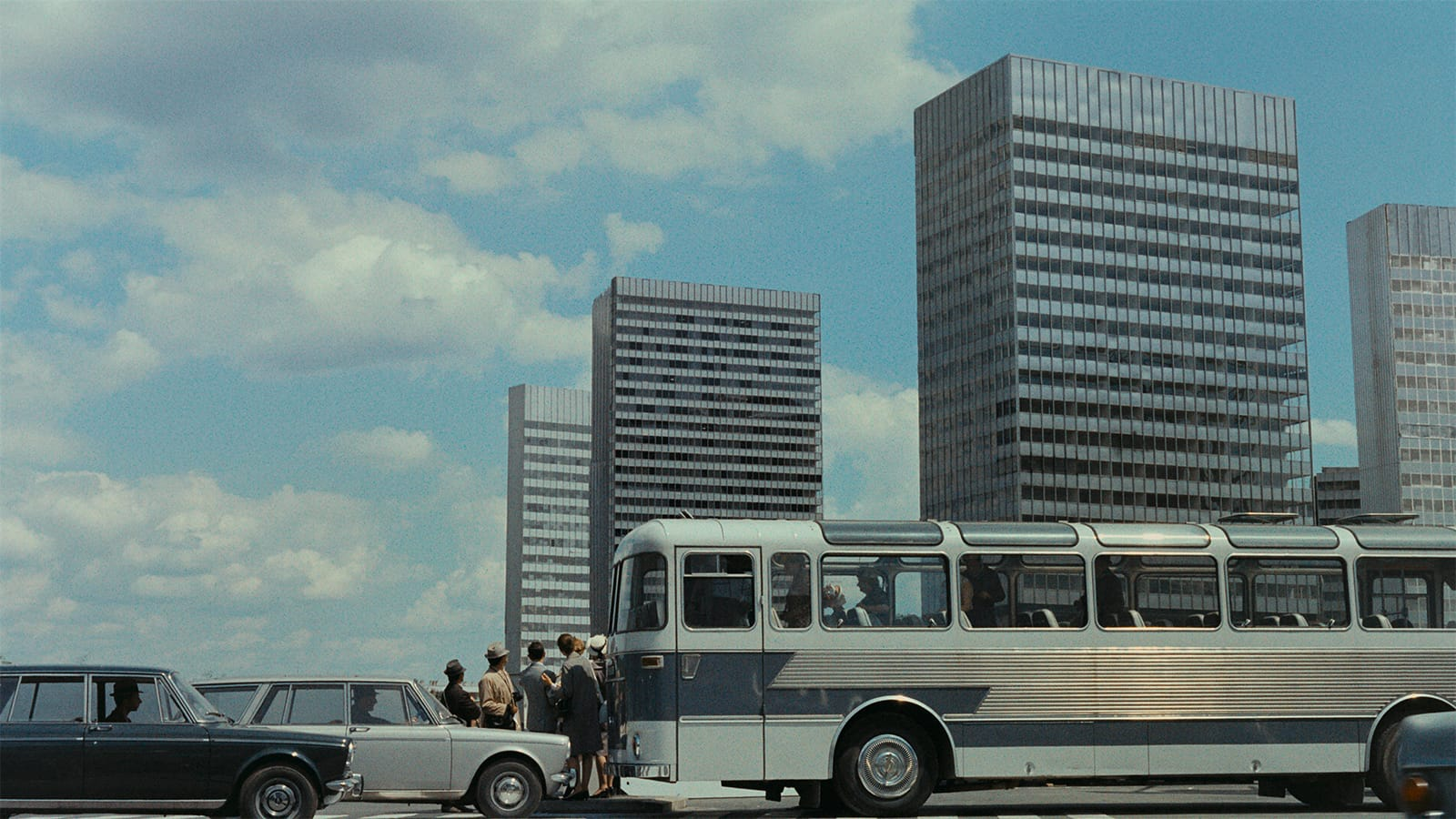
PlayTime (1967). Film still on the Criterion Collection film page. Cinematography: Jean Badal and Andréas Winding.
A modern building can make finding the entrance feel like a small assessment. The door is beautifully aligned with the windows. So beautifully, in fact, that it may be one of the windows. Jacques Tati had a considerable amount of fun with this sort of thing.
PlayTime, released in 1967, sends Monsieur Hulot and a group of visitors through a Paris of glass, polished surfaces and determinedly orderly interiors. The film is interested in what happens when people have to use these spaces. Walking in the right direction ought to be a fairly undemanding ambition.
Its wider compositions leave several possibilities open at once. A person can enter at one side while someone farther away is occupied with something else. A partition can organise the room and make it harder to understand. Looking becomes an activity: finding a face, following a movement, discovering that the place previously taken for a passage isn't one.
A close-up would settle many of these decisions on our behalf. Here, keeping the room visible lets the relationships remain available. A small figure against a large grid looks different from the same figure isolated in a portrait. We can see how much organisation surrounds them, and how little of it has made the afternoon easier.
The colour participates in this. In his Criterion essay on Tati's sound and image, Jonathan Rosenbaum describes the largely monochromatic first half of PlayTime and the more festive colours that arrive later. When a setting is already full of bright accents, another one has competition. Among greys and subdued blues, a modest patch can become unusually noticeable.
It helps to think about the picture as a whole arrangement of attention. Contrast can come from colour, from a figure crossing an otherwise regular pattern, or from one person standing still while others move. No single device has to shout all the time. There is room for something to be found a moment late.
Sound complicates that apparent freedom. Rosenbaum notes that Tati built his soundtracks separately. A noise can prompt a search across the image, or attach unexpected importance to an everyday object. The audience has some latitude, but somebody has put a great deal of work into deciding what might catch its ear.
That combination feels especially interesting beside the habit of judging an image immediately, at a small size. Something clearly separated from its background survives that test well. A busy picture may ask for longer. PlayTime makes a case for accepting the invitation, while remaining funny enough that this doesn't feel like homework assigned by a very disappointed curator.
It would be easy to turn the film into a complaint that modern life is too organised. The better joke is more specific: the supposedly efficient arrangement keeps meeting actual bodies, with their bags, pauses, distractions and uncertain routes. A floor plan doesn't tell us everything that is going to happen on the floor.
There is no need to find every gag on the first viewing. Missing a little of the activity is part of encountering a space large enough to have its own life. If the eye wandered and a joke passed unnoticed, that needn't mean the composition failed.