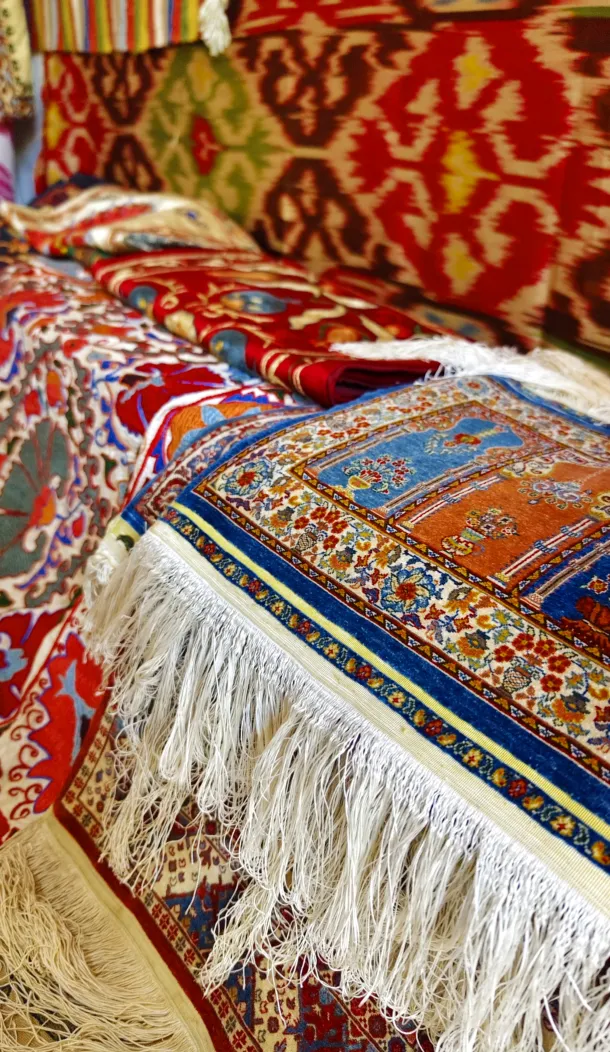
Textiles in UNESCO’s 2023 report on the Crafts Development Center in Margilan. Photo: Mukhayyo Makhmudova. Source: UNESCO.
A textile can become a background very quickly. There it is, full of colour and patient decisions, and someone needs a pleasant surface behind the headline. The cloth is promoted to “visual identity”. Its maker may not even make it into the caption.
This is one reason to read about a craft centre before borrowing its vocabulary. UNESCO's account of the Crafts Development Center in Margilan describes a place established in 2007, with practical and theoretical training supported by its Tashkent office from 2009. The centre's work with atlas and adras entered UNESCO's Register of Good Safeguarding Practices in 2017. The distinction belongs to a practice of keeping knowledge alive, not simply to a handsome piece of fabric.
That detail changes the picture a little. A pattern can be copied without anyone learning how the cloth is made. A skill needs somebody who can demonstrate, somebody willing to learn, and enough time for the learning to become useful. Those conditions are rather harder to download.
The centre's activities also complicate the idea of heritage as something carefully protected from the present. UNESCO's account includes young designers and the development of their own brands. Its separate description of the Atlas Bayrami textile festival, first held in 2015, places training alongside exhibitions and fashion shows. There is room here for making something new, as well as keeping something from disappearing.
It would be easy to turn that into a comfortable story in which tradition and contemporary design always get along. They needn't. A maker may welcome one change and dislike another. Buyers may want a lower price or a quicker delivery. A design may travel much farther than the name of the person who developed it. The fact that a craft is admired doesn't settle any of these negotiations.
Photography has a small but consequential role in what we notice. A tight crop can reveal a weave, or remove every clue that a textile belongs to a larger working life. A wider frame can include a loom or a person without necessarily telling us much about either. There is no morally correct camera distance. The useful question is what the picture leads us to understand, and what the accompanying words bother to name.
In one of the photographs published with UNESCO's centre report, patterned textiles overlap, with long pale fringes spreading across the foreground. The abundance is appealing. But even here, identifying every object as atlas or adras from appearance alone would be a guess. The scene deserves a caption more careful than “traditional fabric”.
Perhaps an interesting way to look at craft is to keep following the nouns. Which cloth? Which technique? Whose workshop? Who is learning it now? The answers make room for differences that a general mood of “heritage” tends to smooth away.
The colours can still be the first thing that catches the eye. They don't have to be the last thing the picture tells us.