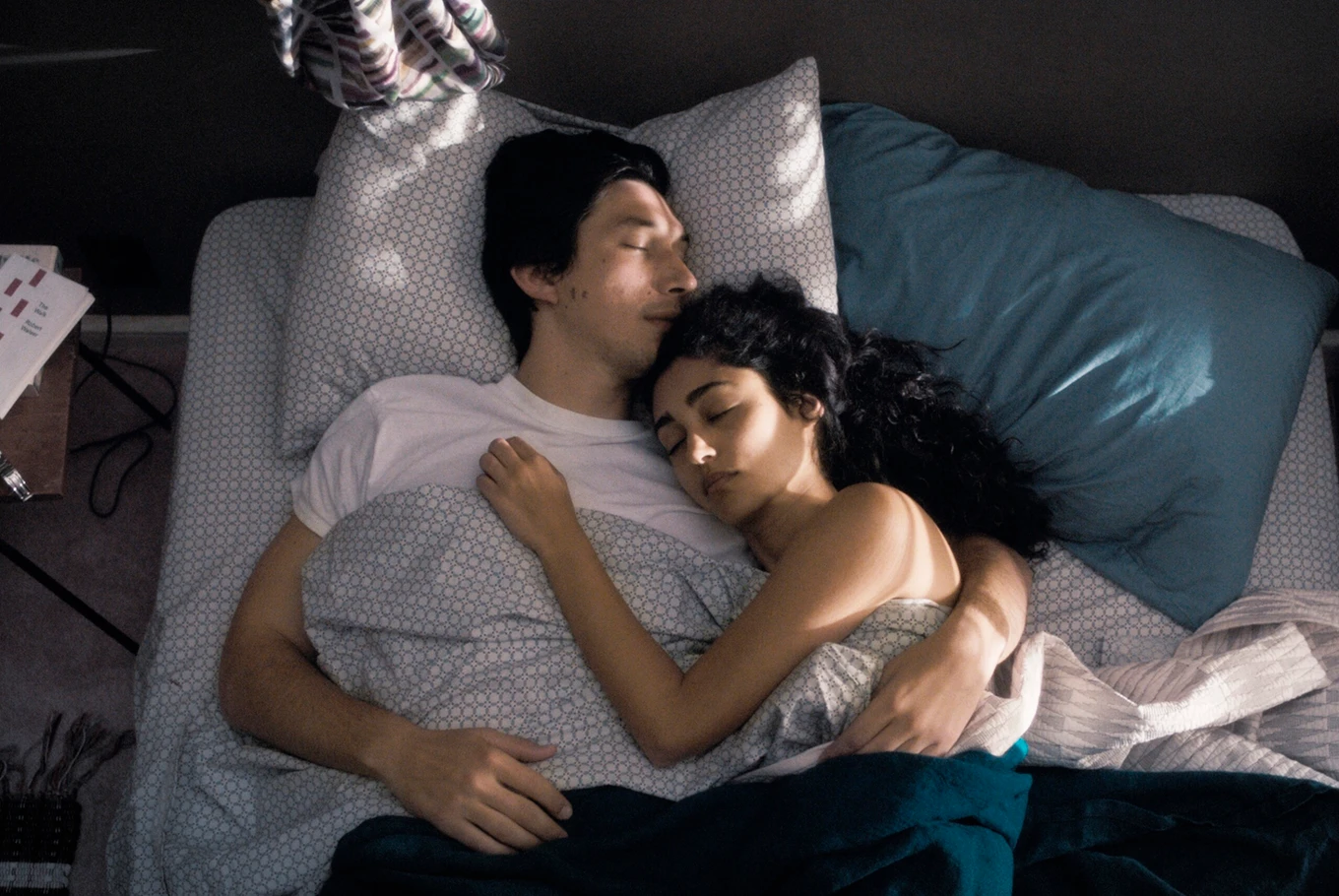
Paterson (2016). © 2016 - Mary Cybulski. Image source: Festival de Cannes.
A notebook can become a surprisingly ambitious purchase. At the point of sale it contains a novel, a collection of poems and a much more interesting version of Tuesday. Later, it may contain a measurement for a shelf.
Paterson gives the notebook a less ceremonial place. In Jim Jarmusch's 2016 film, a bus driver writes poems around the ordinary pattern of his days. The writing has to share time with work, meals, a relationship and a dog. None of those things agrees to wait discreetly outside until art is finished.
The Cannes synopsis establishes the repeated route and domestic routine. The attraction of that structure is how small a variation can become visible inside it. Once a place or action is familiar, the next encounter doesn't need to announce itself as an event. A different conversation can be enough.
There is a useful visual counterpart in the overhead image of Paterson and Laura in bed. Their bodies make an uneven shape inside the straighter edges of pillows and bedding. Patterns repeat, but the people don't become a pattern. The view has enough order to be legible and enough softness to avoid making affection look diagrammatic.
That is a modest description, perhaps, for a film about poetry. But modesty is part of what makes the subject approachable. Writing is often represented at the moment of public arrival: the book exists, the reading is scheduled, somebody has selected an author photograph in which the author appears to be thinking about mortality. Here the private activity can occupy the screen for its own sake.
The poems written by the central character are by Ron Padgett, as the International Film Festival Rotterdam record notes. That distinction matters. A film about a writer still needs somebody to do the writing, and the words deserve an author rather than being treated as another nicely chosen prop.
There is a question here about what a notebook is allowed to hold before it has to become something else. A sentence may be worth keeping without being the beginning of an essay. An observation can remain an observation. It can sit beside an unfinished thought and a perfectly serviceable list of things to buy.
This needn't turn into a programme for becoming more observant. There is enough administration involved in having a day already. It is simply an appealing possibility that a written record can keep different scales of attention together: the large worry, the small detail, the phrase that still hasn't found a home.
The film leaves room to be interested in the work before deciding what sort of success it represents. That seems a good place for a diary to begin. Somewhere between the promising first page and the shelf measurements, there may be something worth returning to.