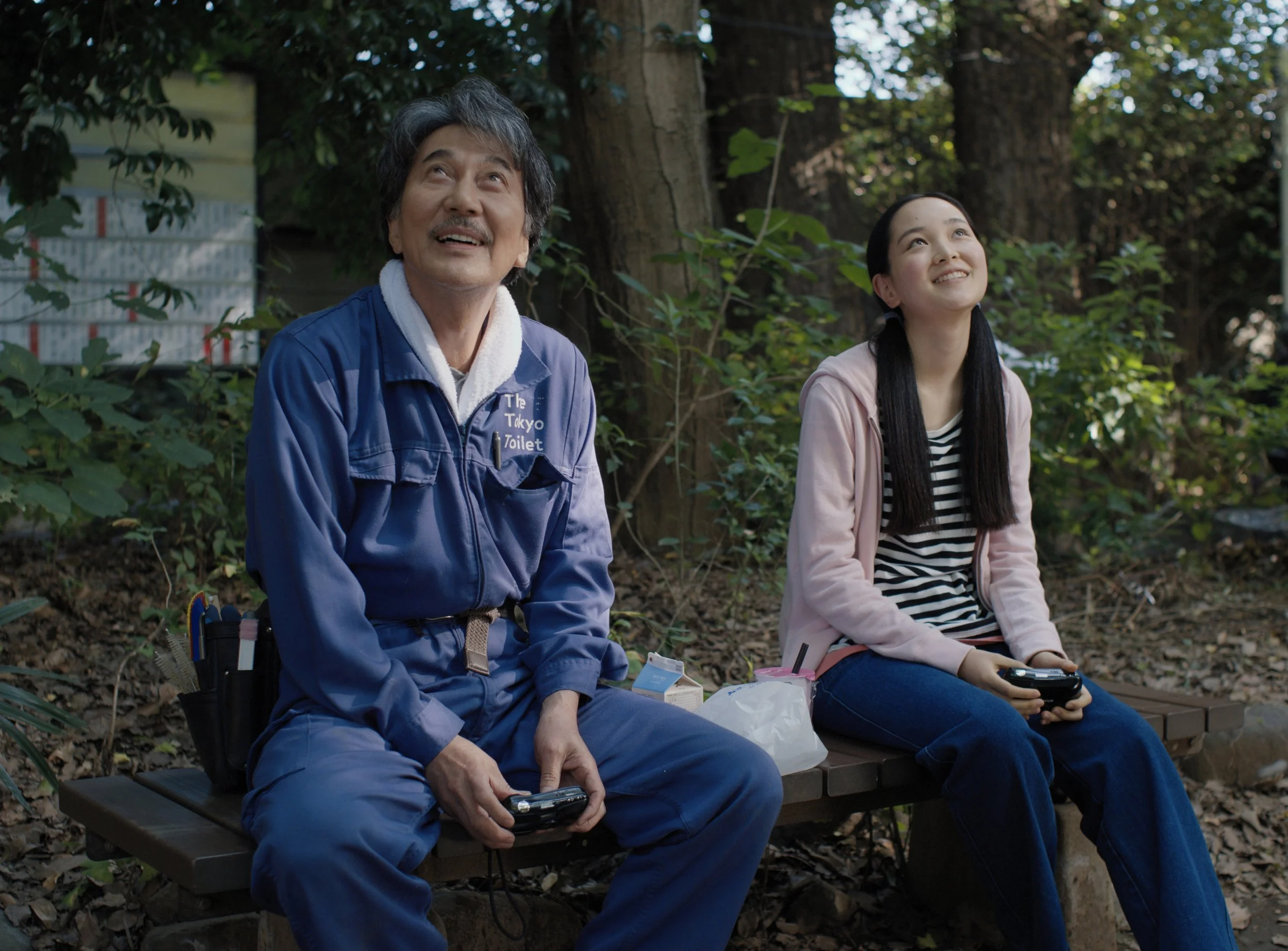
Hirayama and Niko look up beneath the trees, cameras resting in their hands, in Perfect Days (2023). © 2023 MASTER MIND Ltd. Supplied by Haut et Court.
At some point, somebody is likely to ask what you're going to do with all those photographs. It can be a perfectly innocent question. It can also make a pleasant afternoon sound as though it has failed to produce a business plan.
In Wim Wenders's Perfect Days, Hirayama takes photographs of light in the trees during his lunch breaks. He uses a film camera, sorts the resulting prints and keeps them in boxes. The pictures have a place in his life without appearing to require a launch date.
The subject is modest enough to be overlooked: leaves, light, the movement of a canopy. Return tomorrow and it will be recognisably the same place. It will also have changed. The film's closing explanation of komorebi, light filtering through foliage, draws attention to the particular moment that will not occur in exactly the same way again.
I like the possibility of becoming more interested in a place by returning to it. You begin to recognise what the light is doing differently, or notice something you were too busy looking past last time. A familiar subject can support quite a lot of curiosity.
The film camera gives this routine a particular shape. There is time between taking the picture and seeing the print. Then there is the small, physical business of looking, choosing and putting things away. The photographs occupy a little space in the room, as well as in his day.
I don't take this as an argument that film is morally superior to a phone. A phone can keep a marvellous record of the same window, dog or patch of garden. The interesting part is allowing the record to matter without first proving that anyone else will find it impressive.
Hirayama's routine is not a prescription for everybody. The film leaves parts of his past unresolved, and the quieter life it shows has its own limits and sorrows. Admiring his attention doesn't require us to copy his circumstances or pretend that work and money have become simple.
What stays with me is the care he gives these pictures. He bothers to make them, bothers to choose, and then keeps them. Private pleasure gets the same seriousness that is usually reserved for something with an audience.
Perhaps that belongs here, too: room for a picture, or a thought, before it has worked out what it is going to be useful for. The question “What are you going to do with all those?” can wait a little.