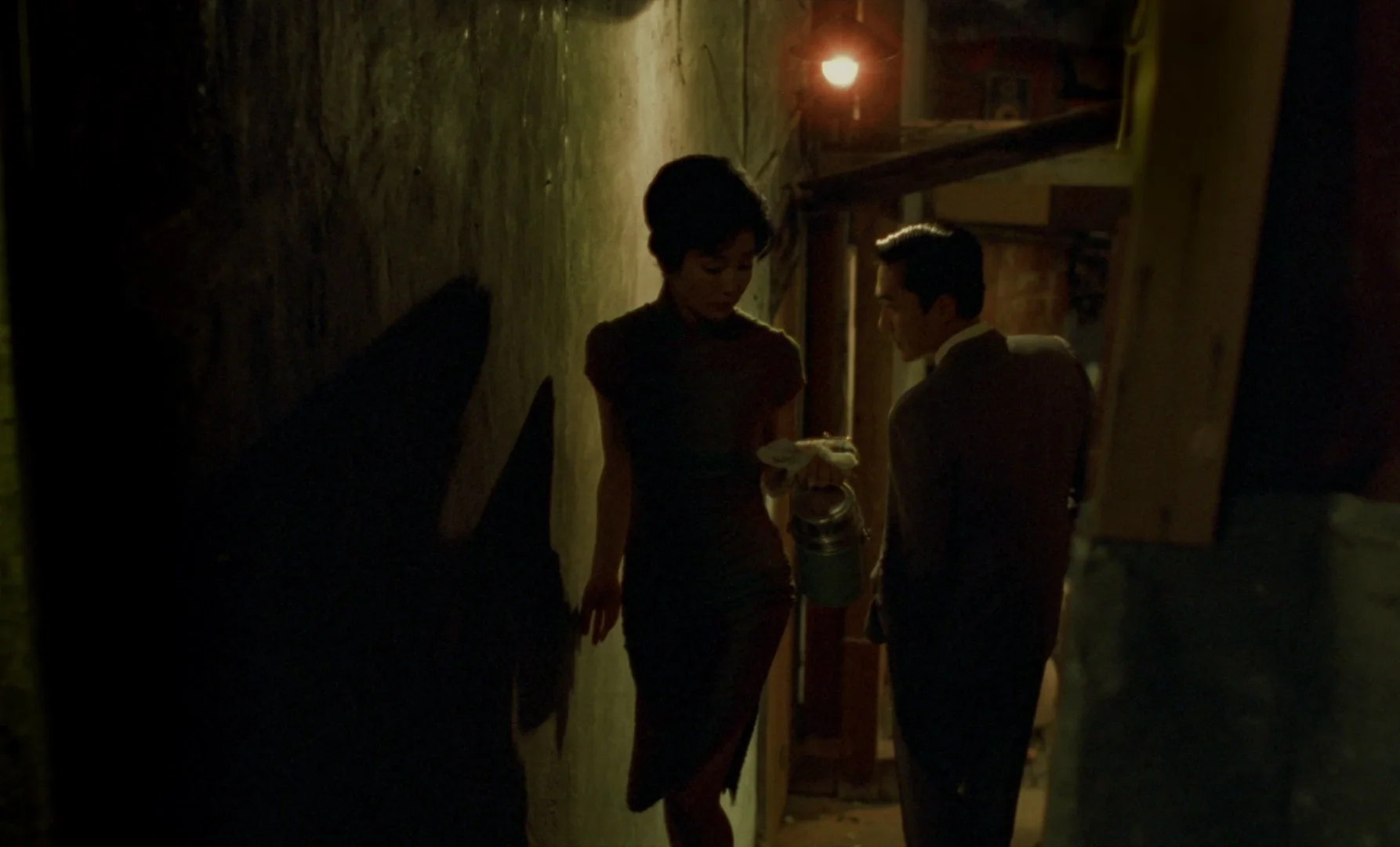
Maggie Cheung and Tony Leung pass on the narrow noodle-stand staircase in In the Mood for Love (2000). Film still supplied by Janus Films.
Going out for noodles is a fairly modest ambition for an evening. In Wong Kar Wai's In the Mood for Love, it becomes something you might remember for the rest of your life.
Two neighbours pass on the stairs. Their movements slow, the music gathers around them, and an ordinary journey begins to feel charged with all the things they cannot comfortably say. They still need their dinner. The film hasn't forgotten that, which is part of what makes the scene so affecting.
Maggie Cheung later described the noodle-stand encounters as two lonely people looking at one another while passing. The restraint matters. A glance is allowed to remain a glance. We have to notice it, rather than wait for someone to explain what it means.
This is where my thoughts wander away from the film a little, towards the private histories of ordinary places. A doorway can become the place where somebody used to wait. A walk to the shops can contain a conversation that neither person has mentioned for years. To everyone else, these are fairly unremarkable bits of pavement.
I can imagine a photograph of such a place needing a little help. “We went here every Thursday” can completely change the picture. Suddenly the uninteresting café frontage has people in it, even if none of them is visible.
The film gives its ordinary journeys that kind of accumulated meaning. Repetition lets us recognise the route; slight changes make us look harder. Familiarity doesn't always make something disappear into the background. Sometimes it is what allows us to notice that something has changed.
I like that Wong leaves some of their privacy intact. We can be close to these people without being handed every answer. And somehow, by the time they have gone for noodles, there is rather more to think about than what they ordered.