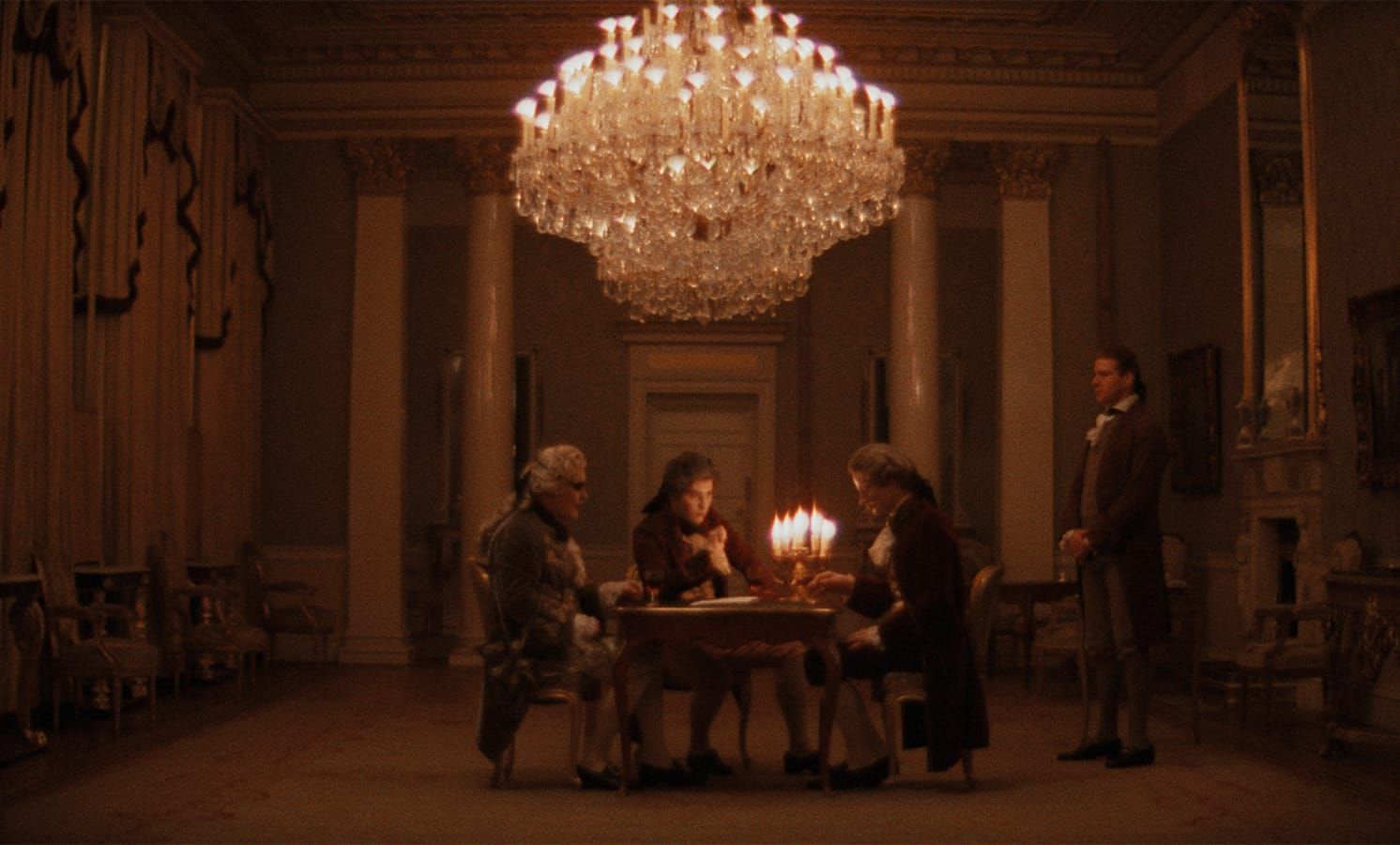
Barry Lyndon (1975). Film still on the Criterion Collection film page. Cinematography: John Alcott.
The famous lens story can rather take over Barry Lyndon. Mention the film and somebody will eventually produce the aperture number, usually with the satisfaction of placing the winning tile in Scrabble.
It is a wonderful piece of engineering. Stanley Kubrick and cinematographer John Alcott used exceptionally fast Zeiss lenses, adapted for the camera by Ed DiGiulio, to film certain interiors by candlelight. But after admiring the equipment, it is worth coming back to the light itself. What would have been lost if the candles had merely appeared in the shot while something else did all the illuminating?
A candle is a small, local source. Near it, a face or a white cuff can become bright; farther away, the room falls off. Several flames make a collection of these small territories. Their position on the table helps determine which part of a face becomes visible and which slips into shadow. The furniture begins to matter to the exposure.
That gives the image a particular social arrangement. People gather around a limited source of light. A conversation across a table also becomes a composition of illuminated faces, dark clothing and intervals of shadow. The room can be splendid without presenting every expensive object with equal enthusiasm. Some of the expense is allowed to disappear into the dark.
Alcott's original American Cinematographer interview makes clear that the candlelight achievement should not be expanded into a claim that the whole film used only available light. He describes artificial units recreating window light elsewhere. He also explains that the very fast candlelight lenses gave the crew extremely little depth of field, making focus difficult. The natural-looking result involved a good deal of highly unnatural organisation.
Depth of field is the range that appears acceptably sharp. With very little of it, a small change in distance can matter. A face can be precise while the room behind it softens. That is different from making every surface look equally crisp. It changes how the eye moves through the image, even before the viewer knows anything about lenses.
Warmth needs some care here too. Candlelight readily suggests comfort, particularly when it arrives with silk and polished wood. A warm photograph can still hold a chilly exchange. The direction of a glance, the distance between bodies and the formality of a posture can complicate the inviting colour. Nobody has promised that an amber room will be a pleasant place to spend an evening.
This is also where calling the film painterly can become a stopping point rather than the start of a thought. Paintings vary enormously. More useful questions are available: where does the light fall, which surfaces carry it, how much of the frame remains dark, and how carefully are the figures arranged within those differences?
The film's credits include Ken Adam's production design and the costumes of Milena Canonero and Ulla-Britt Söderlund. Cloth, skin, wood and white powder do not all respond to the same light in the same way. The look depends on what was illuminated as well as how the illumination was recorded.
The lens made these candlelit scenes possible, preserving small areas of brightness among deep shadows. Parts of the room remain indistinct, and the range of sharp focus is very narrow. The result is interesting to look at without knowing the engineering. Though the person keeping it in focus, one suspects, had quite enough to deal with already.