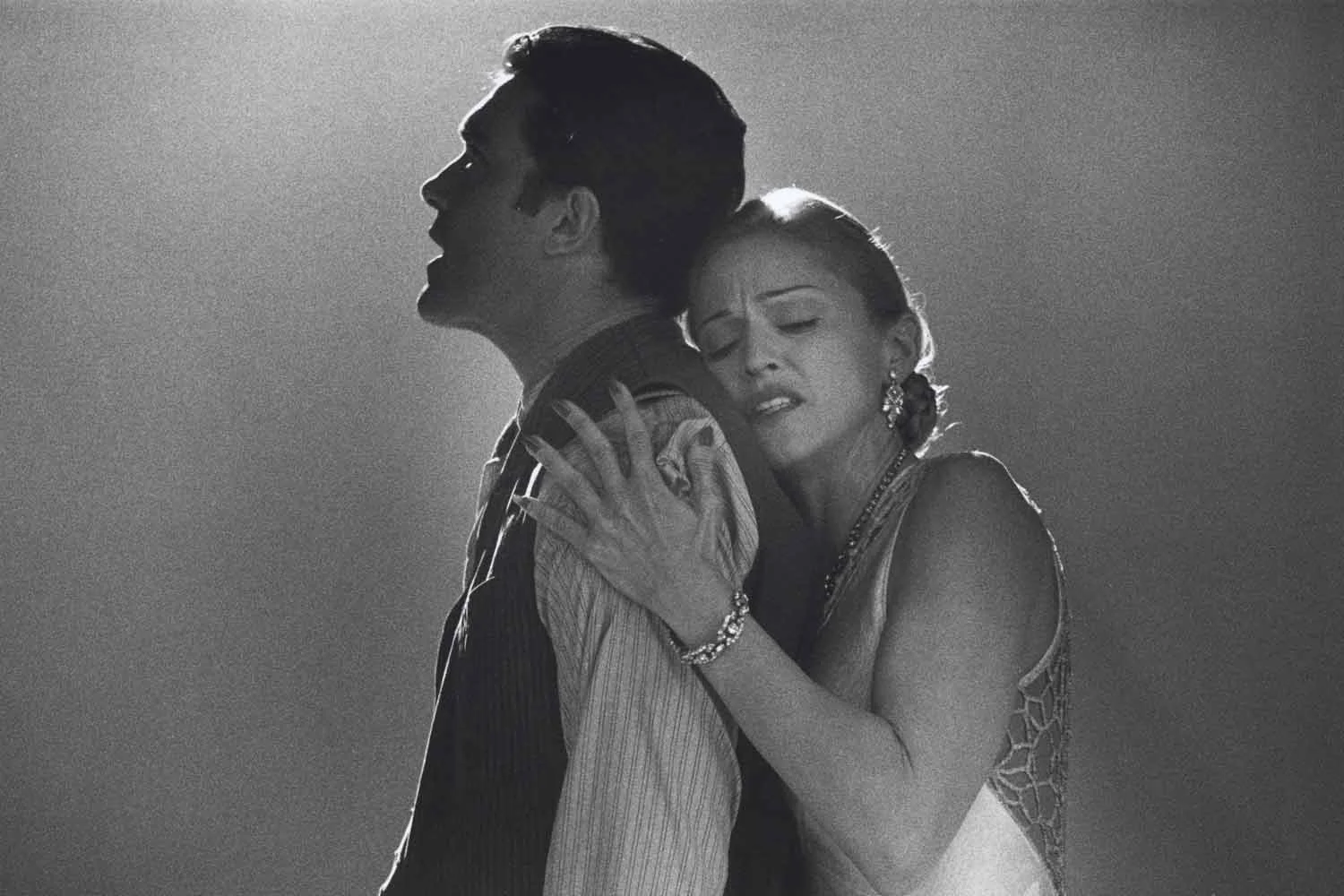
Waltz for Eva (Madonna) and Ché (Antonio Banderas)
All photos © Cinergi Pictures Entertainment, Inc
Stills photography: David Appleby, Bill Kaye
Cinematographer: Darius Khondji
A balcony is an excellent place to look important. You get height, a ready-made frame and, if the film’s budget permits, a whole square of people looking up. All that remains is deciding what to say. In Evita, of course, you’ll also need to sing it.
Alan Parker’s 1996 film casts Madonna as Eva Perón, the actress who became Argentina’s first lady, with Jonathan Pryce as her husband, Juan. Andrew Lloyd Webber’s music and Tim Rice’s lyrics carry almost the entire story. Most musicals occasionally stop talking and start singing. Here, singing is how the conversation happens.
The famous balcony can rather distract from everything else the images are doing. Cinematographer Darius Khondji told American Cinematographer that individual sequences had their own lighting, colour and tempo, responding to the music. Neighbouring scenes didn’t have to look alike. The lighting could follow a change of mood.
Look at the black-and-white production photograph of the waltz included here. The square and the political grandeur have almost disappeared. Madonna’s eyes are closed, her hand resting on Antonio Banderas’s shoulder. Backlight outlines their figures while the surrounding space falls into shadow. There’s very little left to compete with those two people. A small gesture has room to become the whole picture.
Banderas comes with a useful correction, too. It’s easy to take his Ché for Che Guevara, but Parker deliberately rejected that identification. In the film, he’s an everyman narrator who comments on events and asks awkward questions. Clearly, he hasn’t come to this celebration just to clap.
Eva herself deserves more context than a stage persona can hold. She helped campaign for women’s political rights; Argentina passed its women’s suffrage law in 1947. Museo Evita points out that this followed decades of organising by women. Even when a story gathers around one famous figure, the other people don’t disappear.
Then there’s “You Must Love Me”, which Webber and Rice wrote specifically for the film. After the public scale of “Don’t Cry for Me Argentina”, it brings the conversation somewhere much more private. Someone watched by an entire country suddenly seems close.
That’s where the film gets particularly interesting: it creates a feeling of intimacy while we’re still looking at a carefully constructed image. A familiar situation, perhaps, for anyone who has caught themselves feeling they know someone they’ve only seen in photographs or on a screen. Evita just has a bigger orchestra.