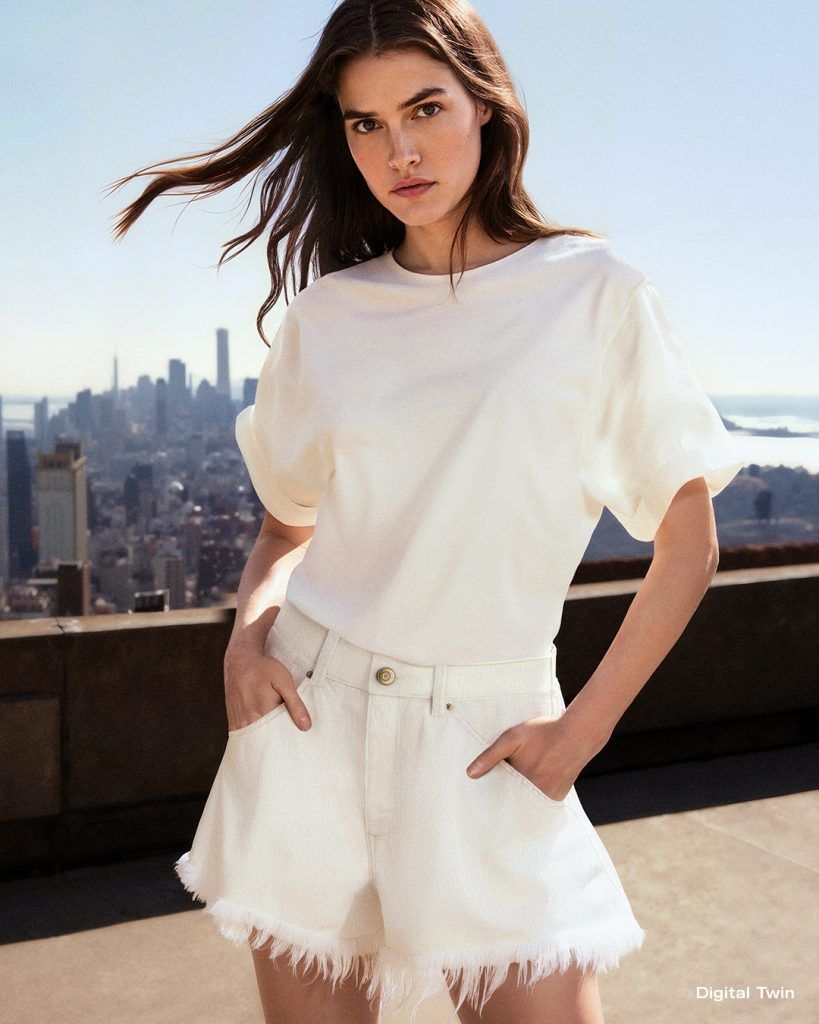
H&M digital-twin campaign image, July 2025. Source: H&M Group. AI-generated imagery; the Digital Twin disclosure is part of the image.
There is a small “Digital Twin” label at the bottom of H&M's July 2025 campaign image. Above it, a figure in a white T-shirt and pale shorts stands against a city skyline. Hair sweeps to one side. The clothes have the familiar ease of an image that has already done all the arranging for us.
The label changes the next question. Instead of wondering where the picture was taken, we might wonder which parts were taken anywhere at all.
H&M's announcement described this as its first release of imagery featuring digital twins, made with a team that included a photographer and a model. That is a documented company project, not proof that fashion photography as a whole has changed overnight. Nor does an announcement tell us everything about contracts, fees or what each person approved. Those deserve their own reporting.
Still, the image opens a useful problem. “AI” covers a lot of possible work. A generated background, a reconstructed likeness and a synthetic garment are different interventions. A single label can alert us to the process without explaining which of these happened. It is a start, rather like a menu admitting that cooking has taken place.
For fashion, the distinction has practical consequences. We may happily accept an impossible landscape in a campaign and still expect a sleeve to correspond to a sleeve we can buy. The wrinkle at an elbow might be part of the styling, a photographed response to movement, or a generated suggestion. Each possibility offers a different kind of information about the garment.
This is where provenance becomes interesting. The C2PA standard provides a way to attach signed information about an image's origin and editing history. Content Credentials can help make that record tamper-evident. They do not establish that the scene depicted is true, or that the creative arrangement was fair. An absent credential is not proof that an image is synthetic, either.
The technical record and the ordinary caption therefore have different work to do. One can help a viewer inspect recorded steps and their signers. The other should say plainly what the viewer is looking at. It would be a shame to build a sophisticated explanation of an image and then hide it behind wording that requires a second explanation.
Consent needs similar care. Permission to create a likeness and permission to use it in a particular situation are questions worth separating. So are approval of a campaign and approval of future variations. These are questions for the people involved, not conclusions that can be drawn from the finished picture.
There is room for imaginative fashion imagery here. There is also room to ask whether the trousers actually fall that way. The two interests can coexist quite comfortably.
What seems worth keeping an eye on is how much of the making remains legible after the image leaves the brand's page. Crops, reposts and screenshots have very little respect for small text in corners. A useful disclosure has to survive the journey, or at least give people a clear route back to the fuller account.