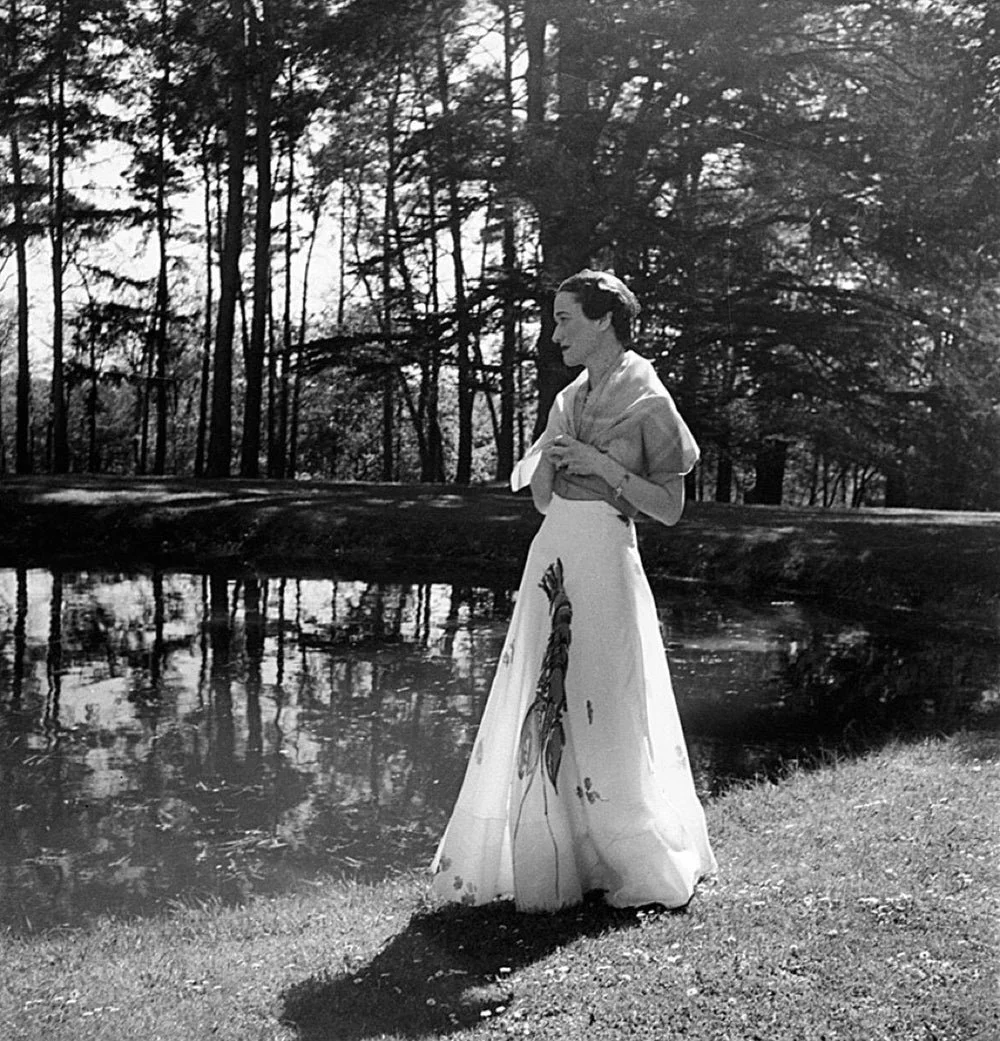
Wallis Simpson in the Schiaparelli lobster dress, 1937. Photograph by Cecil Beaton. Cecil Beaton. Courtesy of the Cecil Beaton Studio Archive at Sotheby's.
An evening dress with a lobster on it sounds as though the evening has already gone slightly wrong. Elsa Schiaparelli’s 1937 dress is considerably more composed than that description suggests.
The pale, flowing garment carries a large lobster motif designed in collaboration with Salvador Dalí. There are little sprigs of parsley too. An unnecessarily thoughtful detail, if you are trying to persuade everyone that this is simply an elegant dress.
The Philadelphia Museum of Art holds an example. But the photograph of Wallis Simpson wearing the design is particularly revealing. In Cecil Beaton’s picture, she stands beside water and trees, her hands gathered near her chest. The setting is calm, the pose formal. Then the eye comes down to the skirt.
The lobster has room to be noticed. Its surroundings don’t compete with it. That is what keeps the image from becoming a jumble of eccentric details: the dress is allowed to be graceful, and the creature is allowed to be absurd. You can enjoy both before deciding what any of it means.
Schiaparelli’s own history places the dress in her summer 1937 collection and records its place in Simpson’s wedding trousseau. The collaboration belonged to a wider conversation between fashion and Surrealism, but the picture doesn’t require a lecture before it can make you smile. A familiar kind of garment has acquired a very unexpected resident.
There is a photographic pleasure here too. The black-and-white image takes colour out of the encounter, so the silhouette and the position of the motif do much of the work. The lobster interrupts a composition that otherwise knows exactly how to behave.
That feels more enduring than the instruction to be bold. “Bold” can mean adding another thing, then another, until nothing is left to notice. Here there is enough quiet around the strange detail for it to keep being strange. Nearly ninety years later, the parsley still seems wonderfully unnecessary.