The surprising part of Pleats Please happens before the clothes look ready to wear: they are deliberately made too big.
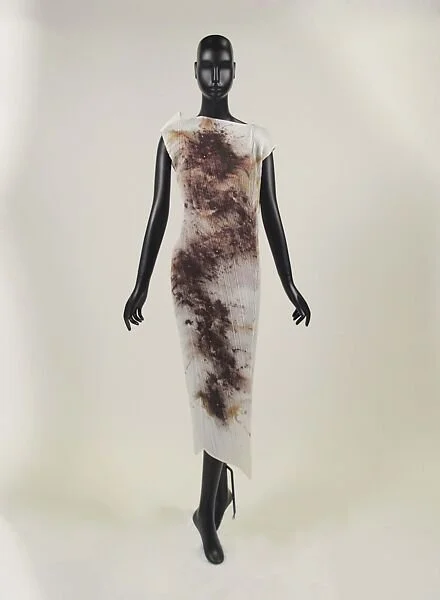
Issey Miyake’s garment-pleating process starts with fabric cut and sewn into a garment. The pleats come afterwards. The Metropolitan Museum describes pieces made at two or three times their intended size, then folded and heat-pressed between sheets of paper. The shrinking into pleats is part of the plan. Nobody has misread the measurements.
That order makes the idea easier to understand. The folds belong to the finished shape, rather than being a decorative fabric chosen at the beginning. They hold the structure and give it room to move.
Pleats Please became a line in 1993. The company still places lightness, ease of movement and machine washing at the centre of its description. There’s something cheering about reading those words beside clothes that look so carefully considered. Laundry has been invited into the design conversation.
The 1999 dress pictured here, with textile design by Cai Guo-Qiang, adds another complication: an image has to live across all those narrow folds. The dark pattern runs down the pale dress while the pleats keep their own rhythm. From a distance it reads as a slender shape. Close up, there’s rather a lot going on.
Issey Miyake, dress with textile design by Cai Guo-Qiang, 1999. The Metropolitan Museum of Art, 2015.530. The Metropolitan Museum of Art, Costume Institute. Purchase, Funds from various donors, by exchange, 2015. Accession 2015.530. Source