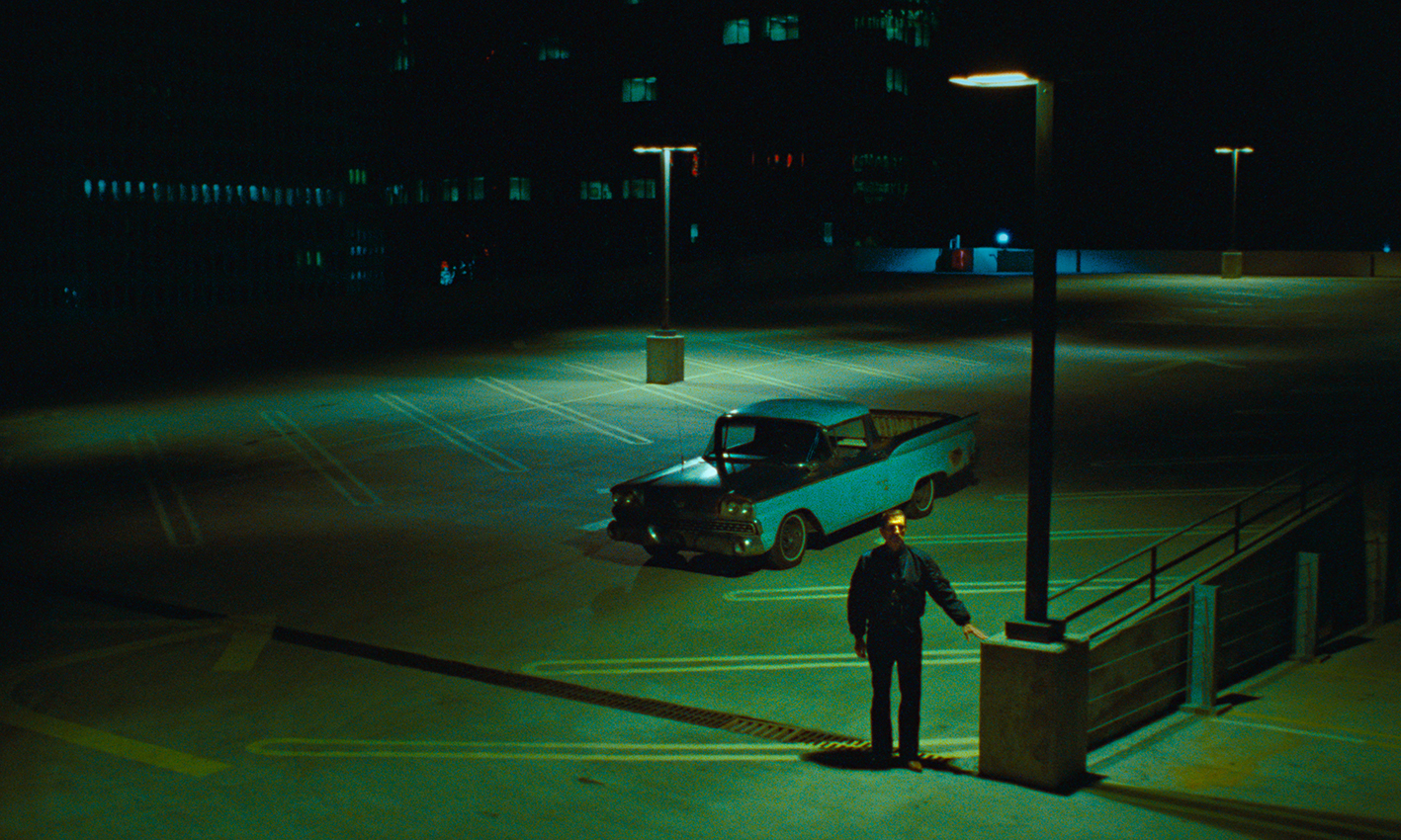
Paris, Texas (1984). A figure and car in pools of green light. Image source: Wim Wenders Stiftung. Cinematography: Robby Müller.
There are photographs in which a red hat is just a red hat. Then there is Harry Dean Stanton walking along a railway line in Paris, Texas, where it is doing a surprising amount of work for something that could be left in a petrol station.
The frame is mostly pale blue sky, dusty vegetation, rails and dark clothing. The cap is a small, concentrated patch of red. Its size matters. Fill half the picture with that red and the whole balance changes. Here it catches the eye, gives the figure a point of recognition and makes him unusually easy to find in all that space.
Already, a strip of five colour swatches would leave quite a lot out. It would tell us which colours are present. It wouldn't tell us how much of each colour there is, where it sits, or what it is attached to. A red hat and a red sky are rather different proposals.
Wim Wenders's 1984 film, photographed by Robby Müller, is particularly good company for this problem. Its colours are strong enough to invite a neat explanation. Red means one thing. Green means another. Very convenient. We could finish the analysis before the kettle boils.
Except Wenders offers a more interesting account. In his interview with Little White Lies, he describes keeping the greenish cast of fluorescent light when a colourist wanted to remove it. Müller wanted that artificial light in the image alongside the light of the American West. The awkward colour was part of the picture they were trying to preserve.
That changes the question. Before asking what green symbolises, it is worth asking where it comes from. A fluorescent fitting is a physical thing in a location. It lights a wall, catches a face and runs out somewhere. The colour belongs to an environment before it becomes available for an interpretation.
The night-time car-park image makes this quite tangible. Green light spreads over the marked bays and the side of the car. Above, the building largely disappears into black. Travis stands low in the frame beside a railing, surrounded by considerably more empty ground than his body occupies. The colour makes that emptiness visible. It doesn't need to make his face green in order to affect the scene.
Imagine neutralising every light source so that skin, walls and white shirts all behave politely. That can be useful. It can also make two quite different places look more alike than they felt. A blue evening outside and a green interior can coexist without being tidied into agreement. Moving between them becomes visible.
There is another useful photograph in the foundation's selection: Hunter sitting at the back of a vehicle, holding a radio. His red shirt is partly covered by a silver jacket. Behind him, the window reflects sky and carries the darker shape of another person. The red finds a small foothold among the blues and greys. It works through the layers of clothing and glass, rather than floating above them as a decorative accent.
This is where a colour breakdown gets enjoyable. How much colour can be hidden before it stops registering? Does it sit in the light or the shade? Is it a surface, a reflection or a glow? Those questions give us more to look at than assigning every hue its own emotion and making the characters stick to it.
There is also the business of which image we are looking at. The Wim Wenders Stiftung records a 4K restoration in 2024, made from a scan of the original 35mm negative. An online still, a restored screening and an old video copy need not present colour identically. Exact colour codes lifted from a random screenshot can acquire a rather impressive air of authority for something that has travelled through several unknown hands.
None of this makes interpretation pointless. The green can feel uneasy; that is a perfectly reasonable response. It just leaves room for the light, materials and choices that produced the feeling. Müller kept a colour that someone else was ready to correct. Staying with that decision for a while seems more rewarding than telling green what it must mean.